Applitools Logo
execute

Deterministic execution, rendered across your entire browser matrix

Orchestrate suites across your pipeline, let self-healing locators absorb the small changes, and run at scale without standing up your own infrastructure.

No flaky runs

Tests render from a captured DOM snapshot instead of holding open a live connection, so results don't depend on network timing or race conditions.

No local grids

Run cross-browser and cross-device coverage from the cloud instead of standing up and maintaining your own device farm.

No manual locator fixes

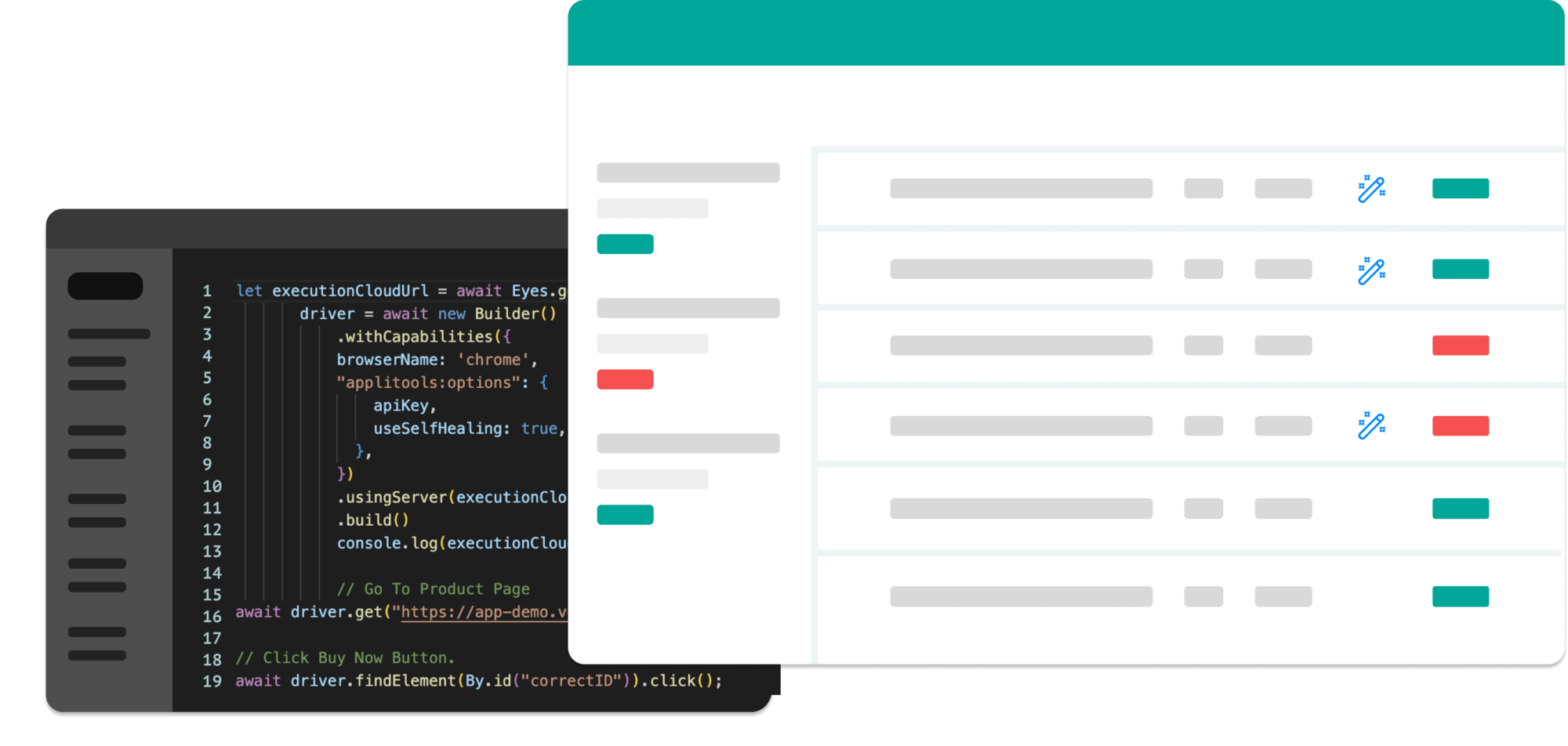
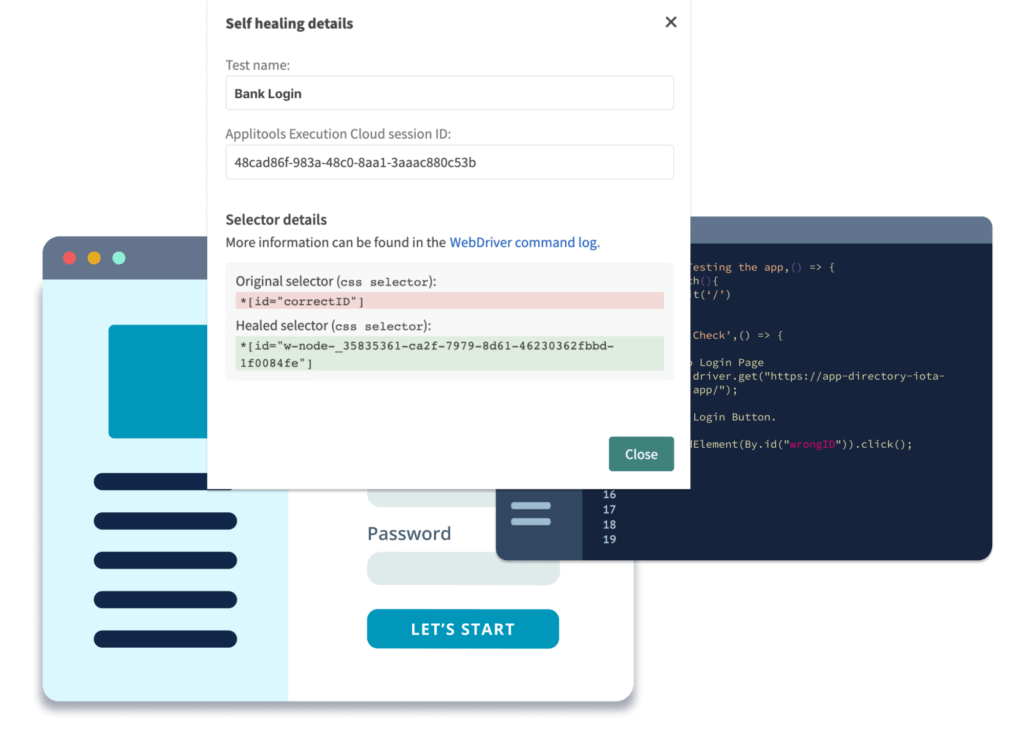
When an element's underlying code changes, Applitools finds it using visual and semantic clues, so a UI update doesn't mean a broken test.

Every result traces back to the same deterministic core

AI coding assistants can refactor a UI in minutes and push changes faster than any release calendar used to allow. Whatever gets orchestrated, healed, or rendered, execution runs on the same Deterministic Language Model and Visual AI, so a red build stays meaningful no matter how fast the code underneath it is moving.
DETERMINISTIC EXECUTION

Get the same result for every run

Coded logic, not a black box
Execution runs on a Deterministic Language Model that computes each step from rules, not statistical guesses, so a failure is a real bug and not a different roll of the dice.

No thinking cycles at runtime
Because the model isn't reasoning through each step live, execution runs faster and the cost stays predictable as your suite grows.

A signal you can act on
A red build means the UI broke. A green build means it didn't. Nothing in between.

TEST ORCHESTRATION

Combine, schedule, and run tests your way

Suites built around how you release
Group tests into suites that match your release process, whether that's a nightly run, a pre-release gate, or a check on every pull request.

Scheduled runs for standing coverage
Set tests to run on a recurring schedule so regressions surface between releases, not just during them.

Triggered from your pipeline
Call test suites through the API from your CI/CD process, so orchestration keeps pace as AI-assisted commits push more changes through the pipeline than a person-paced release ever did.

SELF-HEALING TESTS

Keep tests running when the code underneath changes

Finds elements without exact locators
When a class, ID, or attribute changes, Applitools uses visual and semantic clues to find the same element instead of failing outright.

Holds up against AI-driven refactors
When an AI coding assistant renames a class or restructures a component, Applitools finds the same element instead of failing on an identifier that no longer matches.

Less time on locator upkeep
Spend engineering time writing new tests, not rewriting old ones every time the DOM shifts.

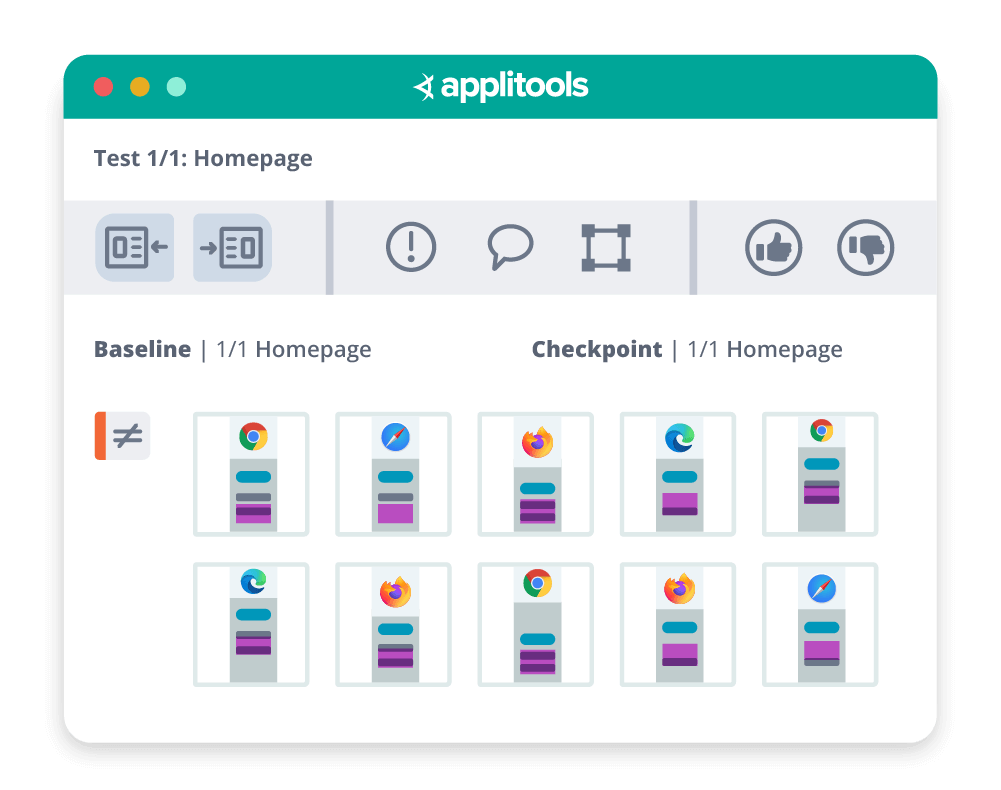
Screenshot showing rendering diffs between Chrome and Firefox browsers in Autonomous
Visual AI

Validate what a user actually sees

One checkpoint replaces pages of assertions
Add the Eyes SDK and a single visual checkpoint validates the full page or component in place of hundreds of lines of DOM assertions.

Built to ignore rendering noise
Visual AI is trained to catch real regressions while ignoring anti-aliasing and other rendering noise that a user would never notice.

Catches what functional tests miss
Functional checks confirm the code ran. Visual AI confirms the interface still looks right, catching layout and rendering issues before a user does.

cross-browser/device testing

Render every browser and device without the wait

Run once, render everywhere
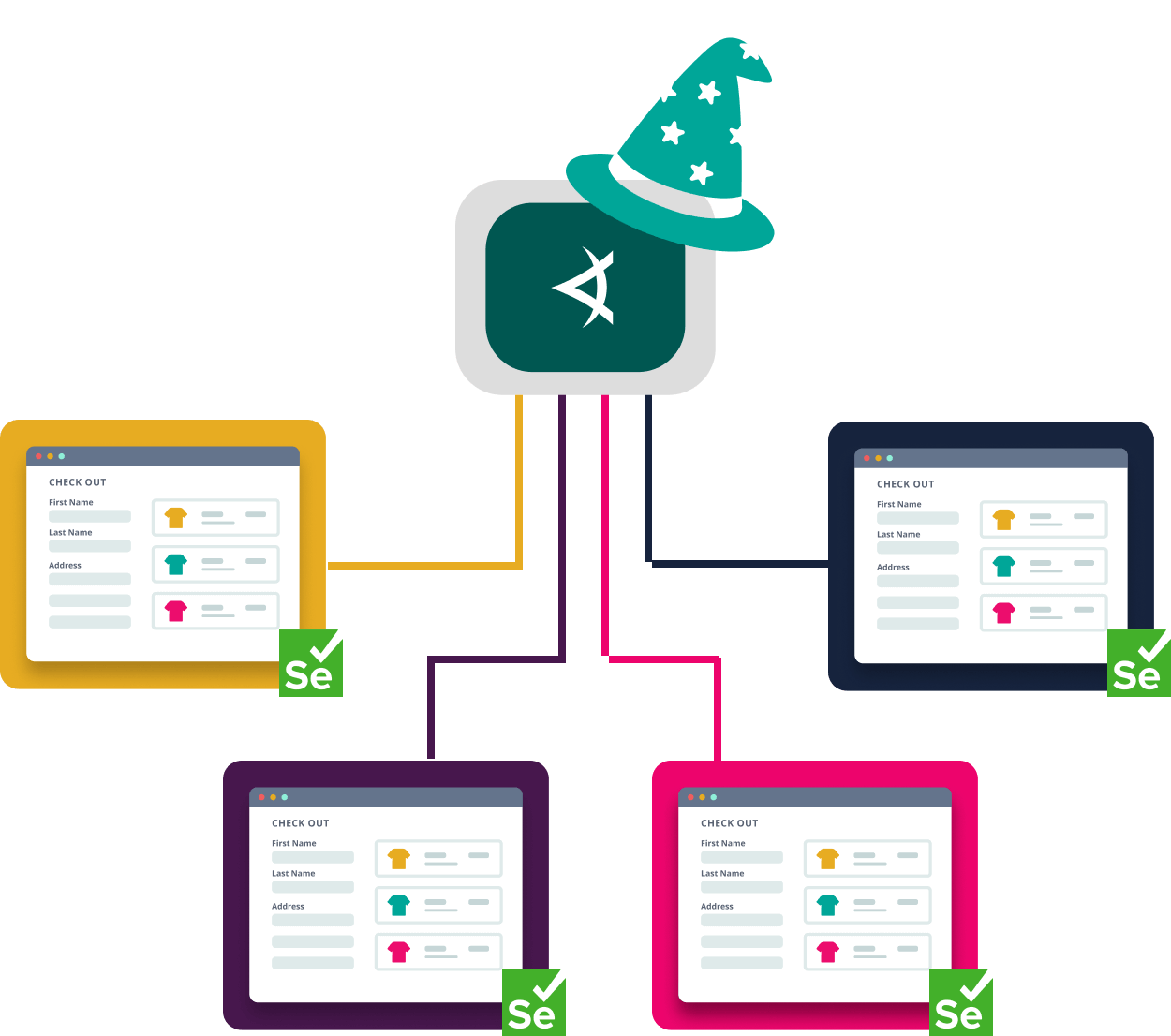
The Ultrafast Grid takes a single local test run and renders it across every browser, device, and viewport you need, instead of re-running your suite on each one.

No live connection required
Rendering runs from a DOM snapshot instead of an open connection to a remote browser, removing a common source of flaky runs.

No separate infrastructure to manage
Skip the reverse proxy, VPN, or self-hosted grid that traditional cross-browser tools depend on.

Screenshot of Autonomous browser and device options

Why the signal holds up at scale

1

Reproducible by design

Every run computes results with a Deterministic Language Model, not a general-purpose LLM. The same input produces the same steps and the same result, no matter how many times it runs.

2

Coverage that scales with your pipeline

Orchestrated suites, self-healing locators, and parallel rendering all run on the same core, so execution keeps pace as your pipeline and your AI-generated code both grow.

3

Built to see like you do

Visual AI ignores anti-aliasing and minor rendering shifts, and flags a change only when it would actually look different to a user.

4

Your app data stays yours

Applitools compares screenshots locally within your environment. App data and anything personal on screen is never used for training.

Run your next suite on infrastructure built to hold up

©2026 Applitools